Rate vs APR
The short version
Your interest rate is what your principal and interest payment is calculated from. It appears on page 1 of a Loan Estimate.
The APR, or annual percentage rate, is broader. It adds points, lender and broker fees, mortgage insurance and some other loan charges to the interest, then states the total as a yearly rate. It appears on page 3, under Comparisons.
Two loans with the same rate can have different APRs when one charges more in fees. A lower APR usually means a less expensive loan if you keep it for many years.
One limitation is that APR spreads upfront costs over the full term. If you sell or refinance sooner, those costs weigh more than the APR shows. Compare APRs only between loans of the same type, term and amount, and look at the fees too.
Rates move every day with the market. When you are ready and the numbers look right, we lock.
Go deeper
What APR counts and what it leaves out
APR is built from the finance charge: the costs you pay because you are borrowing.
- Counted: interest, discount points, origination and underwriting fees, broker pay, mortgage insurance, upfront program fees and prepaid interest.
- Left out: costs the rules treat as part of any real estate transaction, such as the appraisal, credit report, title insurance and document preparation, plus recording fees, property taxes, homeowner's insurance and escrow deposits.
Lenders can treat a few borderline charges differently. That is one more reason to read Section A on page 2 rather than relying on APR alone.
When APR can mislead you
Short stays. Suppose Option 1 has no points and Option 2 has points and a lower rate. Option 2 shows the lower APR, because APR assumes you keep the loan for the full term. If you sell in four years, Option 1 may cost less. The points break-even shows which one does.
Adjustable rates. An ARM's APR does not show how high the rate could go later, so it cannot be compared directly with a fixed-rate APR.
Home equity lines. A HELOC's APR leaves out fees, so it cannot be compared directly with a mortgage APR.
The other numbers on page 3
In 5 years shows everything you would pay in the first five years (principal, interest, mortgage insurance and loan costs) and how much principal you would have paid off. If you expect to keep the loan about that long, it is a more direct comparison than APR.
Total interest percentage, or TIP, is the interest you would pay over the full term, as a percent of the loan amount. It is useful for seeing how much a 15-year term saves compared with a 30-year term.
See it with your numbers
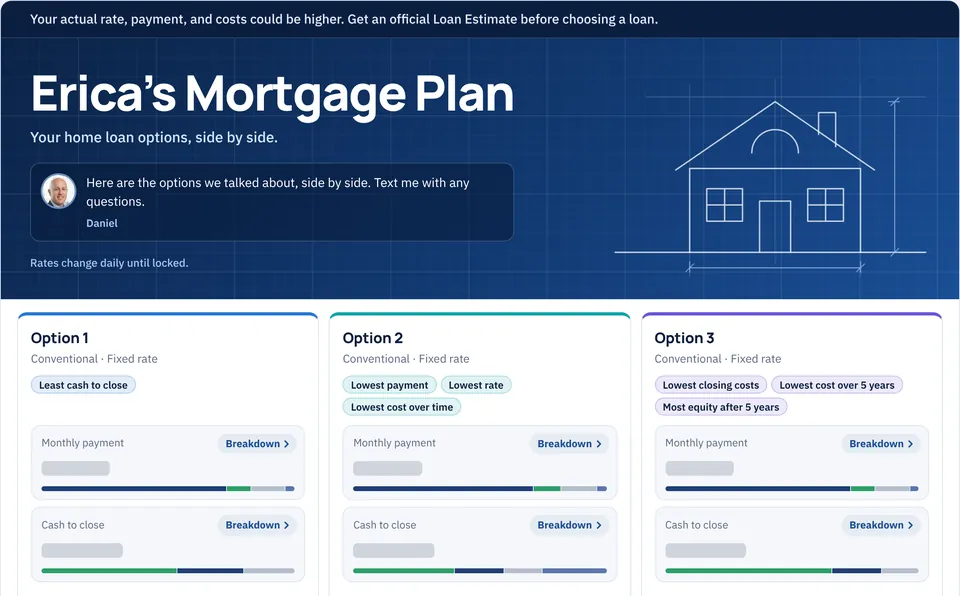
Your Mortgage Plan shows each option's cost over 3, 5, 7 and 10 years, which answers the question APR asks for the time you will likely keep the loan.
Back in your Mortgage Plan, see this with your own numbers.