
Reading a Loan Estimate
The short version
Once you give a lender six things (your name, income, Social Security number, the property address, an estimate of its value and the loan amount you want), it must send you a Loan Estimate within three business days. It is a standard three-page form, so estimates from different lenders line up line by line.
Until you have received it and told the lender you want to proceed, a lender cannot charge you anything except a credit report fee. The figures are valid for 10 business days. If you do not tell the lender you want to proceed within that time, it can revise them.
- Page 1: the loan, the payment over time and the cash you will need at closing. The top shows whether your rate is locked, and until when.
- Page 2: every closing cost, in lettered sections A through J, and how your cash to close is calculated.
- Page 3: comparison figures and the loan's other terms.
Check first that the loan type, term, amount and rate lock match what you asked for.
Sections F and G depend on your homeowner's insurance premium, and in wildfire country that number can vary widely from one insurer to the next. It is best to get real quotes early rather than rely on a lender's placeholder. Colorado's standard purchase contract has a Property Insurance Termination Deadline; ask your agent how it protects you.
Loan Estimate reader
Tap any part of this sample Loan Estimate to see what it means.
This sample Loan Estimate uses fictional numbers. Tap any section to see what it means and what to check.
Page 1: the loan at a glance
Loan termsLoan $285,000. Rate 6.750%. Principal and interest $1,848.50
What it is. The loan amount, interest rate and monthly principal and interest, and whether any of them can go up after closing.
What to check. Every "Can this amount increase after closing?" answer should be NO on a fixed-rate loan. Check for a prepayment penalty or balloon payment. Both should be NO for most home loans.
Projected paymentsEstimated total monthly payment $2,185
What it is. Your payment over time: principal and interest, mortgage insurance, and estimated escrow for taxes and insurance. Columns change when mortgage insurance ends.
What to check. Make sure taxes and insurance are realistic for the property. In Southwest Colorado, acreage and wildfire areas can make insurance much higher than a default estimate.
Costs at closingClosing costs $8,584. Cash to close $17,584
What it is. The two numbers most people look at first: total closing costs and the cash you need to bring.
What to check. Cash to close includes your down payment and subtracts credits. Compare it with your savings, and keep reserves for after closing.
Page 2: closing cost details
A. Origination charges$995
What it is. What the lender (and broker) charge to make the loan, including any points you pay to lower the rate.
What to check. This is the section to compare between lenders. Points here should match the rate on page 1. These fees cannot increase at closing (zero tolerance).
B. Services you cannot shop for$1,042
What it is. Services the lender chooses: appraisal, credit report, flood determination, tax service.
What to check. These cannot increase at closing if the lender chose the provider (zero tolerance).
C. Services you can shop for$1,450
What it is. Mostly title and settlement services. You can choose your own provider.
What to check. If you choose a provider from the lender's list, these together can rise at most 10%. If you choose your own, there is no limit.
E. Taxes and other government fees$175
What it is. Recording fees and transfer taxes.
What to check. Recording fees count toward the 10% group, and transfer taxes cannot increase.
F. Prepaids$2,243
What it is. Your own costs paid ahead: the first year of homeowners insurance and interest from closing to the end of that month.
What to check. These are not fees to the lender, and they are about the same wherever you borrow. A later closing date in the month means less prepaid interest.
G. Initial escrow payment$483
What it is. A starting balance for your escrow account, so taxes and insurance can be paid when due.
What to check. This is usually about two months of each. Federal rules cap the cushion.
H. Other$2,196
What it is. Items such as an owner's title policy or HOA transfer fees.
What to check. Ask who usually pays these in your area. In Colorado the seller often pays for the owner's title policy.
Calculating cash to closeDown payment $15,000. Deposit −$3,000. Seller credits −$3,000
What it is. How the closing costs, down payment, earnest money and credits add up to the cash you bring.
What to check. Your earnest money deposit and any seller credit should show here as subtractions.
Page 3: comparisons and fine print
In 5 yearsTotal paid $120,097. Principal paid off $17,454
What it is. What you will have paid in principal, interest, mortgage insurance and loan costs over the first five years, and how much principal that pays off.
What to check. This is a useful number to compare between offers, since most people sell or refinance within several years.
Annual percentage rate (APR)7.157%
What it is. Your cost over the full term as a yearly rate, including some fees and points.
What to check. Compare APRs on loans with the same term. The APR is not your note rate; your payment comes from the rate on page 1.
Total interest percentage (TIP)133.5%
What it is. Total interest over the life of the loan as a percentage of the loan amount.
What to check. It is higher on longer terms and higher rates, which makes it useful for comparing a 30-year loan with a 15-year loan.
Other considerationsAppraisal, assumption, homeowner's insurance, late payment, servicing
What it is. Notices about the appraisal, whether someone could take over the loan later, late fees and who services the loan.
What to check. Note the late fee and grace period. VA, FHA and USDA loans are often assumable; most conventional loans are not.
Lenders must give you a Loan Estimate within 3 business days of your application. Compare offers from the same day, for the same loan type and lock period. Section D adds A, B and C; section I adds E through H; J is the total.
Go deeper
Page 1, top to bottom
The header names the loan's term (for example, 30 years), purpose (purchase or refinance), product (fixed or adjustable) and type (conventional, FHA, VA or other). Beside it, Rate lock says yes or no, with the date and time the lock ends and when the other closing costs expire.
Loan terms lists the loan amount, rate, and principal and interest, and says whether each can rise after closing. It also flags a prepayment penalty or balloon payment. Ask about any "yes" there.
Projected payments adds mortgage insurance and escrow for taxes and insurance, and shows when the payment changes, such as when mortgage insurance ends. Costs at closing gives two totals: estimated closing costs and estimated cash to close.
Page 2, section by section
| Section | What it includes | Set by |
|---|---|---|
| A. Origination charges | Points, underwriting and processing fees, broker pay | The lender or broker |
| B. Services you cannot shop for | Appraisal, credit report, flood check | Companies the lender chooses |
| C. Services you can shop for | Title and settlement fees, survey, pest inspection | Companies you can choose |
| E. Taxes and government fees | Recording fees, transfer taxes | The county and state |
| F. Prepaids | Homeowner's insurance, interest to month-end, sometimes taxes | Your insurer, county and closing date |
| G. Initial escrow payment | A starting balance for taxes and insurance | Your tax and insurance bills |
| H. Other | Owner's title policy, HOA fees, home warranty | Your contract and local custom |
D totals A through C, and I totals E through H. J is all closing costs, minus any lender credits. Below it, Calculating cash to close starts from J, adds your down payment, and subtracts your deposit, seller credits and other credits.
Page 3: the comparison numbers
In 5 years shows everything you would pay in the first five years (principal, interest, mortgage insurance and loan costs) and how much principal you would have paid off. It is a useful single number for comparing offers prepared the same way. APR states the loan's cost as a yearly rate over the full term. Total interest percentage (TIP) is all the interest over the full term, as a percent of the loan amount.
Other considerations covers your right to a copy of the appraisal, whether a future buyer can take over the loan, the late fee, and whether the lender plans to service the loan or transfer it. The page also lists the lender, any broker and the loan officer with NMLS numbers you can look up at NMLS Consumer Access.
What can change before closing
The estimate is a good-faith promise. Federal rules limit how much each kind of cost can rise by closing:
| Can rise | Which costs |
|---|---|
| Not at all | Fees paid to the lender, the broker or their affiliates; services you were not allowed to shop for; transfer taxes |
| Up to 10% in total | Recording fees, and services you could shop for when you chose a company from the lender's list |
| Any amount | Prepaid interest, property taxes, homeowner's insurance, escrow deposits, services from a company you found yourself, and services the lender does not require |
A lender can send a revised estimate only for a valid reason, within three business days of learning it: you change the loan or down payment, the appraisal or your credit comes in differently, income cannot be documented, or you lock a rate that was floating. Anything charged above the limits must be refunded within 60 days after closing.
See it with your numbers
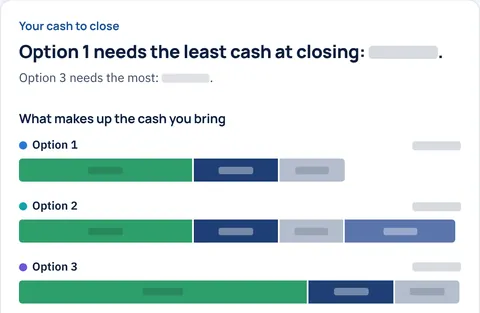
Your Mortgage Plan breaks each option's payment and cash to close into parts, so you will recognize every line when the official Loan Estimate arrives.
Back in your Mortgage Plan, see this with your own numbers.
Your next step
Lesson 5 of 8 in Shopping smartComparing lenders the right wayTo compare mortgage lenders fairly, get Loan Estimates on the same day for the same loan at the same rate, then compare Sections A, B and C on page 2.Read the lessonOr go another way: I have one and want to lock