
Cost over time
The short version
The loan that costs least this month does not always cost least over the years you will keep it. To compare fairly, add up what each option actually costs over time: closing costs, interest and mortgage insurance.
Your down payment is left out because it is not a cost. It is equity. The principal you pay each month is equity too.
Early payments are mostly interest. The share that goes to principal grows every month, so your balance falls slowly at first and faster later.
That is why the time frame changes the answer:
- Points cost more at the start and save more the longer you keep the loan.
- Mortgage insurance that can be removed may move an option ahead after a few years. FHA's lasts the life of the loan with less than 10% down.
- A shorter term costs more each month and far less in total interest.
Go deeper
Why the early years are mostly interest
Each month, interest is calculated on the balance you still owe: balance times the rate, divided by 12. Whatever is left of your principal and interest payment goes to principal.
At the start the balance is at its largest, so interest takes most of the payment. As the balance shrinks, interest takes less and principal takes more, even though the payment stays the same. This schedule is called amortization.
It also explains why extra principal paid early saves the most: it removes balance that would have collected interest for years.
Picking your time frame
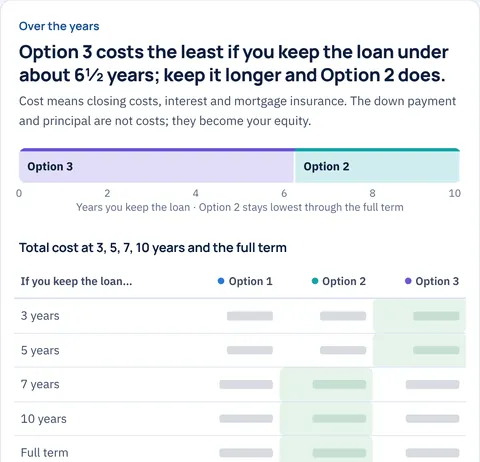
Cost over 3, 5, 7 and 10 years shows how the answer shifts with time. Pick the horizon that fits your plans: a likely job move, a growing family, a plan to keep the place as a rental. If you expect to sell or refinance within a few years, that shortens the horizon too.
Over short horizons, low closing costs tend to win. Over long ones, the lower rate does. When two options trade places between year 3 and year 10, the crossover year is the number to consider.
Extra payments
An extra payment marked for principal lowers your balance right away, so every later payment carries less interest. On most fixed-rate loans it shortens the loan rather than lowering the required payment.
Paying extra early saves the most, because that principal would otherwise have collected interest for decades. Check page 1 of your Loan Estimate to confirm there is no prepayment penalty.
Money paid into the house is difficult to access without selling or borrowing, so weigh it against keeping cash on hand.
See it with your numbers
Your Mortgage Plan shows each option's cost over 3, 5, 7 and 10 years, and what an extra monthly payment would save.
Back in your Mortgage Plan, see this with your own numbers.
Your next step
Stage 4: Finding the homeAgents, offers and contingenciesYou now sign a buyer agreement before an agent tours homes with you. In your offer, earnest money and contingency deadlines decide when you can cancel.Read the lessonOr go another way: I am already under contract