Comparing lenders the right way
The short version
Rates and fees change daily, so a fair comparison needs estimates from the same day for the same loan: same price and down payment, same loan type and term, same lock period, and the same interest rate.
Then compare two things side by side:
- The interest rate, on page 1, to confirm it is the same.
- Sections A, B and C, on page 2. A is what the lender itself charges. B and C are outside services tied to the loan.
Sections E through H matter much less. Taxes, insurance, prepaid interest and escrow deposits depend on the home and your closing date, not the lender. An estimate that shows less there is not less expensive. It is simply based on different assumptions.
Ask each lender for an official Loan Estimate, not a fee worksheet, so the figures fall under federal limits. Shopping has little effect on your credit, because mortgage credit checks within 14 to 45 days, depending on the scoring model, count as one inquiry.
Where to look on a Loan Estimate
Every lender uses the same federal form, so each line sits in the same place on every estimate. Here it is one part at a time. For every section of the form, see the Loan Estimate reader.
Step 1 of 6 Page 1
Page 1: the loan terms
Start on page 1. Before comparing costs, check that the loan amount, loan term, loan type, rate lock and interest rate are the same on every estimate.
Loan EstimatePage 1 of 3 · Example figures
Sale Price$300,000Loan Term30 yearsPurposePurchaseProductFixed RateLoan Type ConventionalRate Lock Yes, until a set dateLoan TermsCan this amount increase after closing?
Loan Amount$285,000NOInterest Rate6.750% ExampleNOMonthly Principal & Interest$1,848.50 ExampleNODoes the loan have these features?
Prepayment PenaltyNOBalloon PaymentNOProjected Payments
Page 1 of a Loan Estimate: the loan details at the top and the Loan Terms table, marked. Example figures. Step 2 of 6 Page 2
Section A: Origination Charges
Section A is what the lender charges to make the loan, including any points paid for the rate. At the same interest rate, this is the main place offers differ.
Loan EstimatePage 2 of 3 · Example figures
Closing Cost DetailsLoan Costs
A. Origination Charges$995% of Loan Amount (Points)Underwriting Fee$995B. Services You Cannot Shop For$1,042Page 2, Loan Costs, with Section A marked: points and the underwriting fee. Example figures. Step 3 of 6 Page 2
Section B: Services You Cannot Shop For
Section B lists services the lender requires and chooses, such as the appraisal and the credit report. You cannot shop for them, so compare the section total.
Loan EstimatePage 2 of 3 · Example figures
Closing Cost DetailsLoan Costs
A. Origination Charges$995B. Services You Cannot Shop For$1,042Appraisal Fee$800Credit Report Fee$132Flood Determination Fee$10Tax Service Fee$100C. Services You Can Shop For$1,450Page 2, with Section B marked: appraisal, credit report, flood and tax service fees. Example figures. Step 4 of 6 Page 2
Section C: Services You Can Shop For
Section C lists services the lender requires that you can shop for, mostly title and settlement. The lender gives you a list of providers, and you can choose another.
Loan EstimatePage 2 of 3 · Example figures
Closing Cost DetailsLoan Costs
B. Services You Cannot Shop For$1,042C. Services You Can Shop For$1,450Title – Closing Protection Letter$25Title – Document Preparation$100Title – Lender's Title Policy$700Title – Settlement Agent Fee$600Title – Tax Certificate$25D. Total Loan Costs (A + B + C)$3,487Page 2, with Section C marked: the title and settlement fees. Example figures. Step 5 of 6 Page 2
Section D: Total Loan Costs
Section D adds A, B and C. The Other Costs below it, Sections E through H, depend on the home and the closing date, not the lender.
Loan EstimatePage 2 of 3 · Example figures
Closing Cost DetailsLoan Costs
A. Origination Charges$995B. Services You Cannot Shop For$1,042C. Services You Can Shop For$1,450D. Total Loan Costs (A + B + C)$3,487Other Costs
E. Taxes and Other Government FeesF. PrepaidsG. Initial Escrow Payment at ClosingH. OtherPage 2, with Section D marked: the total of A, B and C. Sections E through H are below it. Example figures. Step 6 of 6 Pages 1 and 2
Two estimates, side by side
Line up the same lines from each estimate. When both are from the same day and at the same interest rate, the difference in Section D is the difference in loan costs.
Loan EstimateTwo estimates · Example figures
Line Estimate 1 Estimate 2 Date Issued Same day Same day Loan Amount $285,000 $285,000 Interest RateExample 6.750% 6.750% A. Origination Charges $995 $2,420 (differs) B. Services You Cannot Shop For $1,042 $1,042 C. Services You Can Shop For $1,450 $1,450 D. Total Loan Costs $3,487 $4,912 (differs) Two example estimates from the same day at the same interest rate. Estimate 2 charges half a point for that rate, so Section A and Section D differ.
Illustration only. Your plan shows your own numbers.
Go deeper
Reading the difference
When one estimate has the lower rate and the other has lower fees, turn the gap into time. Divide the extra upfront cost by the monthly savings to get a break-even month, the same way you would with points.
Then check the total. The In 5 years figure on page 3 adds principal, interest, mortgage insurance and loan costs, which makes it a fair single number when both estimates were prepared the same way.
If the two estimates are at different interest rates, they are not comparable yet. Ask both lenders to quote the same rate, then compare the points, credits and fees each one charges for it.
What the lender is held to
Federal tolerance rules make some lines firmer than others:
- Sections A and B cannot go up unless something changes, such as your loan amount, the appraisal or a rate that was not locked yet.
- Section C can rise up to 10% in total if you use a company from the lender's list, and by any amount if you choose your own.
A low Section A is therefore a firm number, while a low Section C is an estimate. Title and settlement charges come from the title company, not the lender, so if two estimates are far apart there, ask why.
Why a broker helps
Comparing three retail lenders means three applications. A Mortgage Broker takes one application and compares wholesale pricing from many lenders on the same day, which is the comparison this lesson describes.
Federal rules apply either way. A loan originator's pay cannot be based on your rate or loan terms, and on one loan it cannot come from both you and the lender. A broker's pay shows in Section A, so you can see it.
Through many wholesale lenders, a Mortgage Broker reaches nearly every residential loan. The one thing a broker does not offer is a bank's in-house loans, which it keeps for its own customers. What brokers save, on average.
Questions to ask every lender
Ask each lender the same questions, in writing if you can, so the answers line up:
- Is this rate locked? For how many days, and what does an extension cost?
- Does this rate include points or a lender credit?
- Which fees in Section A could still change, and why?
- Will you service the loan, or transfer it?
- What would make this estimate change before closing?
See it with your numbers
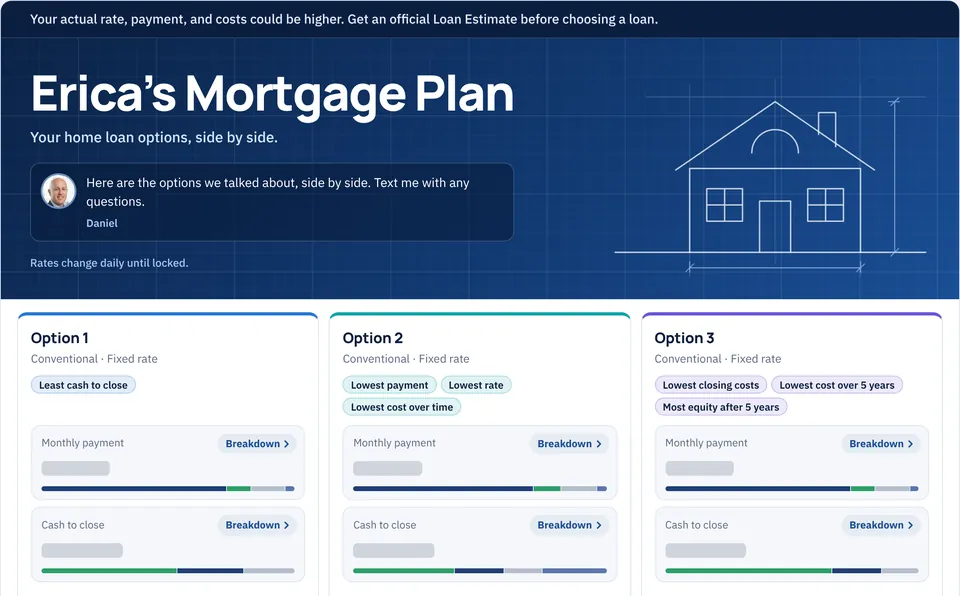
Your Mortgage Plan gives each option its own card with its payment and cash to close, and fact tags mark the lowest payment and the least cash to close among the options showing.
Back in your Mortgage Plan, see this with your own numbers.