
Paying extra on your mortgage
The short version
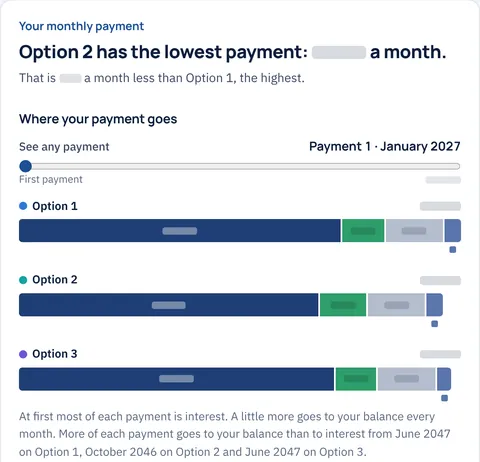
Early in a loan, most of each payment goes to interest. Anything extra you pay goes straight to principal, which lowers the balance interest is charged on from then on. That is why extra payments early in a loan save more than the same payments later.
- Send it correctly: mark extra money as principal, then check your next statement to see it applied.
- Your required payment stays the same: the loan just ends sooner.
- Penalties are rare: FHA, VA and USDA loans do not have prepayment penalties, and most conventional loans do not either. Your Loan Estimate and note state whether yours has one.
- An added benefit with PMI: on a conventional loan, extra payments help you reach the point where mortgage insurance can be removed sooner.
Before prepaying, most people build an emergency fund and pay off higher-rate debt first. Money in your home is difficult to access quickly.
Go deeper
Monthly, yearly or a lump sum
All three approaches work. The earlier the money goes in, the more interest it saves.
- Monthly: a set amount added to each payment. This is easy to automate.
- Biweekly: half a payment every two weeks adds up to 13 full payments a year. You can do this yourself at no cost. Be careful with paid biweekly programs; the CFPB has sued a company over misleading savings claims.
- Lump sum: a one-time payment, such as a bonus or tax refund. Some servicers will recast a loan after a large lump sum, lowering the payment for a fee. Many do not. Ask yours before you rely on it.
Prepay or put the money elsewhere?
Every extra dollar of principal saves interest at your mortgage rate, with no risk. That rate is the number to compare against.
- Debt with a higher rate costs you more than your mortgage does.
- Savings and investments may earn more or less than your rate, with different risk.
- Cash you can reach matters. To get equity back out, you would need to sell, refinance or borrow against the home.
There is no single right answer. It depends on your rate, your other debts and how much cushion you have.
Paying extra to drop PMI
On a conventional loan, you can ask to remove mortgage insurance once your balance reaches 80% of the original value, and that point can come early if you have paid extra. It ends automatically at 78% on the original schedule.
Extra payments do not remove FHA mortgage insurance. With less than 10% down, it stays for the life of the loan no matter the balance. Removing it requires refinancing.
See it with your numbers
Your Mortgage Plan shows how an extra payment changes the payoff date and total interest for each option.
Already have a Mortgage Plan? Open your link, or text Daniel.
Back in your Mortgage Plan, see this with your own numbers.
Your next step
Lesson 3 of 8 in OwningDropping mortgage insuranceConventional mortgage insurance can be dropped at 80% of the original value and ends at 78%. FHA and USDA insurance work differently.Read the lessonOr go another way: I would rather lower my rate