
Should you refinance?
The short version
A refinance replaces your mortgage with a new one. It comes with closing costs, usually an appraisal, and a new payment schedule. It makes sense when the new loan does something specific for you:
- Lower the rate or payment
- Remove mortgage insurance
- Take cash from your equity
- Change the term: shorter to pay off sooner, or longer to lower the monthly payment. A longer term still lets you pay extra and finish sooner.
Every goal comes down to one test: whether the savings or benefits outweigh the costs over the time you will keep the loan.
If you have an FHA, VA or USDA loan, a streamline refinance may reach that goal with less paperwork. Choose your goal to see the best path.
Go deeper
What a refinance costs
Expect lender fees, an appraisal, title insurance for the new lender and recording fees. You will also fund a new escrow account and prepay some interest, but those are not true costs. The escrow is your money, and your old servicer must refund the old escrow balance within 20 business days of payoff.
A "no-cost" refinance still has costs. They are paid by a lender credit in exchange for a higher rate. That can make sense if you might move or refinance again soon.
A new 30-year term is a limit, not a schedule
A new 30-year term does not mean 30 more years of payments. It sets the longest the loan can run, not how long you have to take. Keep paying what you pay today, and the difference goes to principal, so at the lower rate the new loan can be paid off on or before the date your current loan would end.
For example, if you are six years into a 30-year loan, a new 30-year loan lowers the payment partly by allowing six more years. If you pay only the new, lower payment, you can pay less each month and more in total. Paying your old amount, or choosing a shorter term such as 20 or 25 years, keeps the payoff date where it is or brings it closer.
The refinance calculator shows both: tap "Keep today's payment" to see when the new loan would be paid off.
When not to refinance
- You expect to sell before the savings repay the costs.
- The monthly savings are small next to the costs.
- You want cash, but your current rate is low. A second mortgage on top may cost less than re-pricing your whole balance.
- Your credit or income has changed since you bought, and a full refinance would be priced less favorably than you expect. Ask us to check before an appraisal is ordered.
See it with your numbers
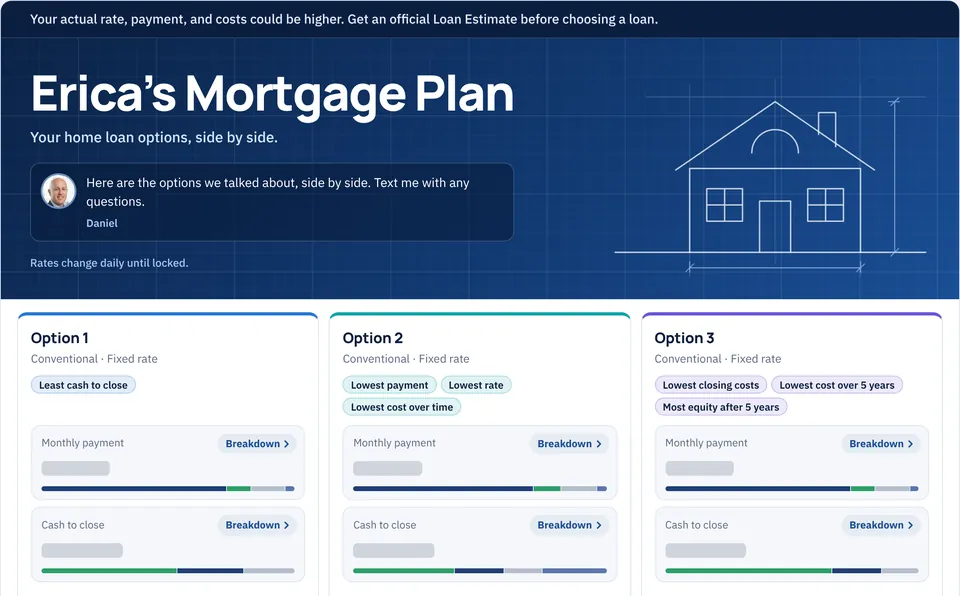
Your Mortgage Plan compares your current loan with each refinance option and shows the refinance break-even.
Already have a Mortgage Plan? Open your link, or text Daniel.
Back in your Mortgage Plan, see this with your own numbers.
Your next step
Step 2 of 7Will it pay off? The break-evenDivide the cost of refinancing by the monthly savings to find how many months it takes to come out ahead. Then check the total cost over time.Go to step 2Leave the path: Take cash outGet rid of mortgage insurance